- Sect pilgrim hymn of Asahisan Shinshoin
- 朝日山 真を照らす 集う民 心地良いかな 先祖の泉
- Mount Asahi, illuminating the truth, people gather here, how comforting it is, the fountain of our ancestors
-
Explanation
The light that rises over Mount Asahi (or illuminates Mount Asahi) reveals the truth. Those who gather there spend time in profound comfort by the side of a pure spring passed down from their ancestors.
It expresses the refreshing scenery of Asahisan Shinshoin and the current state of its faith.
- The light that illuminates truth:
- True to the name “Mount Asahi,” the rising sun shines upon all things, symbolizing the revelation of hidden, ultimate truth (shinnyo).
- The gathering of people:
- Guided as if by that light, many people come together and share moments of tranquility.
- The fountain of our ancestors:
- The phrase “the fountain of our ancestors” refers not merely to a waterside, but likens the wisdom and virtues handed down through generations and the presence of a guardian spirit to pure water that flows forth unceasingly.
- Sect pilgrim hymn of the Main Image of Shinshoin, the Thousand Armed Kannon Bodhisattva
- 登り来て 千手のみ手に すがりなば よろずの思い 晴れて嬉しも
- Climbing up to this place, if I cling to the thousand hands, then countless worries are cleared away and my heart is filled with joy.
-
Explanation
Having climbed the steep mountain path and arrived here, if one clings to the hands of the Thousand Armed Kannon Bodhisattva, how joyful it is that the countless worries and anxieties carried thus far are completely swept away.
- “Nobori kite” (Climbing up to this place):
- This phrase symbolizes not only the physical hardship of the steep mountain path, but also the long journey toward the Buddha, the trials and sufferings encountered throughout life.
- “Senjunomiteni sugarinaba” (if I cling to the thousand hands):
- It expresses the act of entrusting oneself entirely to the countless hands of the Thousand Armed Kannon Bodhisattva, embodiments of boundless compassion and relying upon them with one’s whole heart.
- “Yorozu no omoi harete ureshimo” (then countless worries are cleared away and my heart is filled with joy):
- This line emphasizes the joy of salvation, in which innumerable worries and attachments dissolve, leaving the heart clear, light and filled with gladness.
- Denomination
- Omuro school of the Shingon Sect of Buddhism
- The main image
- the Thousand Armed Kannon Bodhisattva
- Mantra
- On bazara tarama kiriku
- Founder
- Monk Kangen
- Year of Foundation
- Kanpyo 8 (896)
- Address
- 5106 Aiofutajima, Yamaguchi-shi, Yamaguchi-ken 754-0893
Historical Background
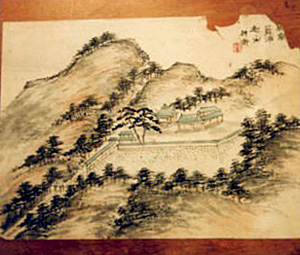
This temple is said to have been founded in Kanpyo 8 (896) by Monk Kangen of Ominokuni Ishiyama Temple. At that time, it was known as Asahisan Shokan Temple Senkoin and served as a Shingon Esoteric Buddhist training hall for Denpo Kanjo, complete with a full complex of seven temple buildings.
However, in Tensho 14 (1586), a fire destroyed the temple buildings and the temple was merged into Shinzenbo in Tensho 16 (1588). Then, in a mysterious turn of events, around the Jokyo era (1684–1687), a spiritually efficacious light was seen every night at the former site of Senkoin. In response, Kaiken, who was the head priest of Shinzenbo, built a Kannon Hall there. This location is where the present Asahisan Shinshoin stands. Seikai Hoi, who is the founder of the Aio 88 Sacred Holy Places, was a head priest of Henmyoin, but he was originally the head priest of this temple.
Asahisan Shinshoin was established in Meiji 2 (1869) through the merger of three temples: Senkoin, which stood on Mount Asahi, Shinzenbo (founded in Kanpyo 8) ,which was in Negi and Henjo temple, which is also located in Negi (whose founding date is unknown).
Taking one character from each of the three temples, shin (真) from Shinzenbo, sho(照) from Henjo temple, and in (院) from Senkoin, it was named Shinshoin. In Showa 17 (1942), the main hall, the wake hall and all temple treasures were destroyed by fire. However, the Thousand Armed Kannon Bodhisattva of the Main Image, survived unharmed. In Showa 38 (1963), the main hall which was constructed of reinforced concrete and the oldest in Yamaguchi City was completed and the temple now stands in majestic form as a central site of the Pilgrimage to Aio 88. The main hall is the 58th stop of the Aio 88 Pilgrimage. Within the temple grounds are also the 54th stop (Daishi Hall), the 64th stop (Daishi Hall) and the 69th stop (Okunoin). In addition, the grounds enshrine thirty three images of Kannon modeled after the Saigoku Thirty Three Kannon Pilgrimage and Myoken, the guardian deity of this shrine.
The Thousand Armed Kannon Bodhisattva of the Main Image answered prayers for a safe childbirth, good fortune and exorcisms so that worshippers can remain connected to the sacred space. The view from the temple grounds is magnificent and on clear days, we can see across the Suonada as far as Kyushu and Shikoku. Many visitors say that there is an ancient mysterious atmosphere on the temple grounds.